Showing posts with label Renault. Show all posts

Sunday, September 19, 2010

Dacia Duster

The Dacia Duster is the first crossover SUV developed by the Romanian automaker Automobile Dacia. Officially revealed on 8 December 2009, it became available in Europe from 18 March 2010. Based on the Nissan B0 platform, the Duster measures 4.31 metres (169.7 in) in length, 1.82 metres (71.7 in) in width and has 210 mm (8.3 in) of ground clearance. Its luggage space has a volume of up to 475 litres (16.8 cu ft), while with the rear benchseat folded and tipped forward, its carrying ability can exceed 1,600 litres (57 cu ft).


Dacia Duster features Bosch 8.1 ABS, as well as EBD electronic brakeforce distribution and EBA emergency brake assist. It also features ESC electronic stability control as an option on certain versions, as well as CSV understeer control and ASR traction control. This option also allows torque to be transferred away from a spinning wheel in 4x4 mode to improve traction when diagonal wheel spin occurs.


Renault Design Central Europe presented, at the 2009 Geneva Motor Show, a concept car named Dacia Duster. This concept vehicle (a SUV/sports coupe crossover ) addressed the needs of families, with a roomy cabin in a compact package and a large 470 L (124 US gal; 103 imp gal) trunk. The car had a very efficient motor capable of emitting 139 grams of carbon dioxide per kilometer and a fuel consumption of 5.3 L (1 US gal; 1 imp gal) per 100 km (62 mi). The Dacia Duster was the first concept car entirely made by Dacia. The Duster normally had four seats but can be converted into a two seat car, the passenger seat slides under the driver's seat and the right back seat slides under the left back seat freeing an extra room of 2,000 L (71 cu ft) ideal for a bicycle.


The Duster concept car had a Dacia Logan 1.5 litre inline-4 engine equipped with Bosch Mono-Jetronic fuel injection producing 106 PS (78 kW; 105 hp) at 5400 rpm and 240 newton metres (180 ft·lbf) at 2000 rpm of torque. It was a front engined, two-wheel drive or four-wheel drive vehicle based on the Nissan B platform. It accelerated from 0 to 100 km/h (62 mph) in 9.6 seconds. If the model had been produced, its initial price would have been around 15,000 euro (US$ 18,750).

Monday, September 6, 2010

New Renault Megane Sport


The Markel Phillips Renault Mégane is a small family car produced by the French automaker Renault since 1995. It is offered in 3- and 5-door hatchback, saloon, coupé, convertible and station wagon bodystyles. The Renault Scénic (launched 1996) is the first modern compact MPV to be built in Europe, and is based on the Mégane floorpan.

New Mégane Renault Sport is powered by a new-generation 2-litre 16-valve turbocharged petrol engine which boasts maximum power of 250hp (184kW) at 5,500rpm and peak torque of 340Nm from 3,000rpm. The sum of the different improvements made to this engine has produced a gain of 20hp and 40Nm over Mégane R26.R which itself emerged as the yardstick in the world of performance hatches. The Renault Sport 2.0 T engine's twin-scroll turbo is exceptionally responsive and is particularly flexible at lows revs, with 80 per cent of maximum torque available from 1,900rpm. Its broad useful rev band makes it a genuine joy to drive in everyday use, and the pleasure remains all the way up to the rev-limiter whenever it is pushed a little harder. The engine of New Mégane Renault Sport drives through a six-speed manual gearbox.

Work has also gone into the acoustics of the Renault Sport 2.0 T engine to produce a telltale sporty pitch audible inside the cabin under acceleration.

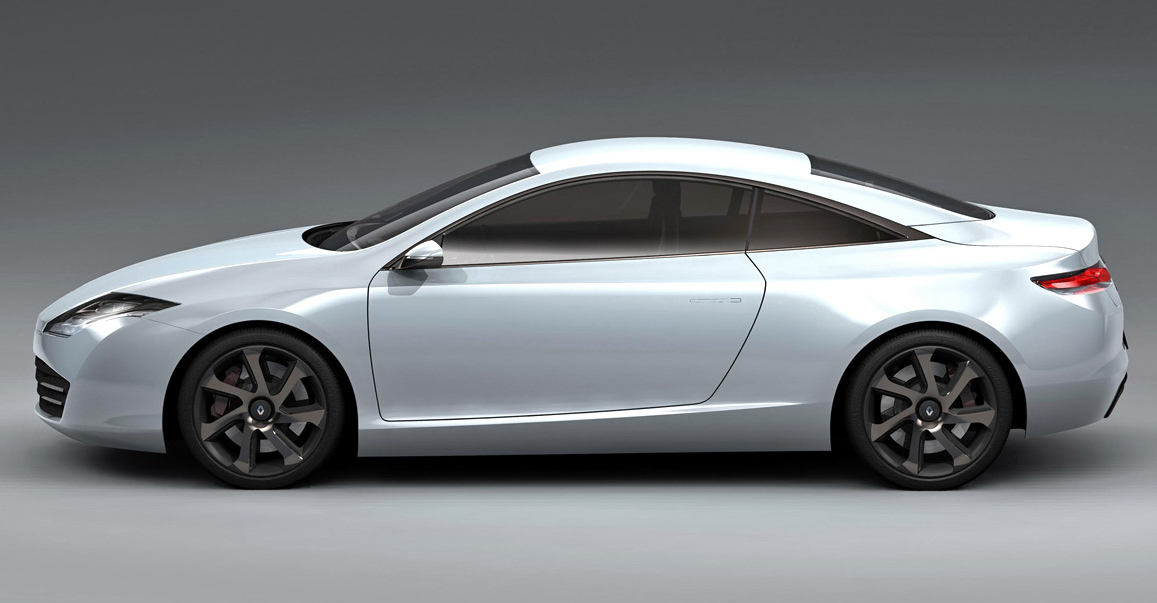
Renault Laguna Coupe


The Renault Laguna is a large family car produced by the French manufacturer Renault. The first Laguna was launched in 1993, the second generation was launched in 2000, and the third generation was made available for sale in October 2007.

The first generation Renault Laguna was launched in December 1993 as replacement for the Renault 21, initially coming as a hatchback only. Late in 1995 it was introduced an estate version, known in some markets as the Laguna Sport Tourer, and replaced the 21-based Renault Savanna/Nevada.

With its responsive handling, precise steering and stable cornering, Laguna Grand Tour is ideal for high-mileage drivers. Laguna Grand Tour also features the highest standards in safety and travelling comfort, boasting top-level soundproofing and air conditioning, standard-setting suspension, and the finest in safety technology, including ABS, ESP, electronic emergency brake assist, and a double side airbag.

Laguna Grand Tour station wagon is extremely roomy and strong on stowage compartments. The seats fold in one click to reveal a completely flat load area measuring 1,593 dm3, complete with compartments and a full-length luggage cover. With plenty of room for bags and bulky objects, it excels on holidays and business travel.

Depending on the engine, Laguna Grand Tour meets the Renault eco² criteria. Special mention goes to the 110 hp 1.6 dCi with CO2 emissions limited to 130 g/km. Laguna Estate is manufactured in the ISO 14001 certified plant of Sandouville and contains 17% recycled plastics.

Followers